


Cloud Adoption Guidance
Cloud adoption transforms how businesses operate, collaborate, protect data, and scale. For small and medium businesses the cloud is not just a place to store files. It is a platform for innovation, a tool for operational resilience, and a path to global collaboration. This guide walks you step by step through cloud adoption, from assessment and planning to migration, governance, and continuous optimization. It focuses on pragmatic actions you can take today to reduce risk, control cost, and realize the benefits of cloud technology quickly.
Why Cloud Adoption Matters
Cloud adoption enables organizations of every size to access enterprise grade capabilities without heavy upfront investment. With cloud services you can scale compute and storage on demand, deploy applications rapidly, and give teams secure access to tools and data from anywhere. Cloud adoption improves agility, lowers time to market, and makes innovation continuous rather than episodic.
For small and medium businesses, cloud adoption often means the difference between competing locally and competing globally. The cloud reduces barriers to entry for advanced analytics, automation, collaboration, and secure remote work. It allows businesses to adopt best in class systems for customer relationship management, accounting, operations and communications with a predictable consumption based cost model.

Getting Started: Assessment and Readiness
Every successful cloud journey starts with an honest assessment. This is not a technical checklist only. It combines business priorities, current technology, team skills, regulatory constraints, and financial realities. Assessments answer critical questions: which systems are suitable for the cloud, what will migration cost, what are the security and compliance implications, and how will users be impacted?
A practical assessment includes: inventorying applications and data, identifying dependencies, measuring performance needs, evaluating current operational processes, and checking compliance requirements for data residency or industry specific rules. This phase produces a prioritized migration backlog rather than a one size fits all migration plan.
Many teams use a risk based approach: move low risk, low complexity workloads first to learn the process and build repeatable patterns before tackling mission critical systems. This phased approach reduces business disruption and provides early wins to build confidence.
Choosing Cloud Models and Providers
Cloud is not a single product — it is a set of delivery models and provider choices. The primary models are SaaS (software as a service), PaaS (platform as a service), and IaaS (infrastructure as a service), each offering different levels of control and responsibility.
SaaS is the fastest route to value for many small businesses. Applications like email, CRM, accounting, file sharing and marketing platforms are consumed as services. For custom applications PaaS and IaaS offer the infrastructure to build and host solutions while minimizing server management.
Provider choice matters. Global hyperscalers like AWS, Azure, and Google Cloud offer broad capabilities, deep security controls and extensive partner ecosystems. There are also specialized providers and regional clouds that offer compliance advantages. Multi cloud strategies distribute workloads across providers to reduce vendor risk and increase resilience, but they add complexity.
Cloud Model Short Guide
SaaS
Ready to use cloud software. Best for standard business functions like CRM, email and accounting.
PaaS
Platform for building and deploying applications without managing servers. Good for custom apps.
IaaS
Virtual servers and networks you control. Offers maximum flexibility, more management overhead.
Designing a Cloud Roadmap
The roadmap translates assessment findings into staged actions. It captures timelines, success metrics, migration sequences and responsibilities. A pragmatic roadmap lists what to migrate, how to migrate it, the acceptance criteria, and rollback plans in case of issues.
Roadmaps should be realistic and iterative. Start with foundation components like identity management, backups and monitoring. Then move to migration of stateless apps and non critical workloads, followed by databases and complex integrations once confidence and repeatable procedures exist.
Define success metrics: performance, uptime, cost targets, security posture and deployment frequency. Track these continuously and adjust the roadmap based on actual results and changing priorities.
Security, Compliance and Identity
Security must be foundational, not an afterthought. Cloud providers offer extensive security tooling but misconfiguration is a leading cause of breaches. Implement identity centric security with least privilege access, multi factor authentication, and role based access controls. Use managed identity services where possible to centralize authentication and authorization.
Data classification helps determine encryption, residency and retention requirements. Sensitive data may require encryption at rest and in transit, specialized key management, and stricter audit trails. Ensure logging and monitoring are configured to detect suspicious activity and support incident response.
Compliance is industry specific. For businesses handling healthcare information, GDPR, or financial records, verify that your provider and chosen services meet applicable certifications and controls. Use provider compliance documentation and automated compliance scanning tools to reduce manual overhead.

Data Migration Strategies
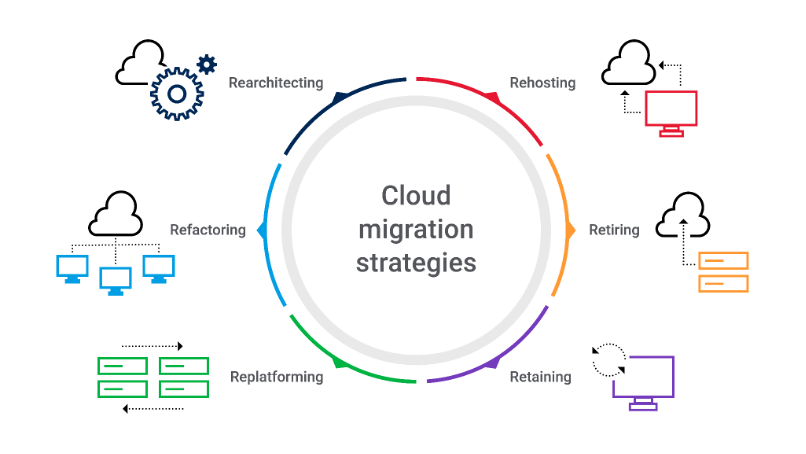
Migrating data is often the most delicate step. Choose a migration strategy that fits data size, downtime tolerance and application complexity. Common strategies include:
Lift and shift: Move applications and databases to cloud VMs with minimal changes. Fast but may not deliver cloud native benefits.
Replatform: Make small optimizations while migrating such as moving to managed databases. Reduces operational burden and improves performance.
Refactor: Rebuild applications to use cloud native services for scalability and resilience. Offers the best long term return but requires greater effort.
Always validate integrity after migration. Use checksums and staged validation, run parallel systems during transition where necessary, and maintain backups until cutover is complete and verified.
Migration Checklist
Inventory
List applications, dependencies, data volumes and integrations.
Test Plan
Define testing, rollback steps, and acceptance criteria.
Backup & Validation
Ensure backups and data validation before and after migration.
Cost Management and Optimization
The cloud operates on a consumption model which brings predictability but can also cause surprise spend if left unmanaged. Cost management involves tagging resources, setting budgets and alerts, and reviewing usage regularly. Right size instances and leverage reserved instances or committed use discounts where appropriate.
Use monitoring and budgeting tools from your provider and implement automated policies to stop unused resources during off hours. Educate teams on cost implications of resource choices and track cost per project or customer to attribute spend effectively.
Operational Practices and DevOps Culture
Cloud adoption benefits multiply when teams adopt DevOps practices. Continuous integration and continuous delivery pipelines that automate testing and deployment reduce human error and accelerate releases. Infrastructure as code allows environments to be version controlled, tested and reproduced reliably.
Encourage cross functional collaboration between development, operations and security. Automate security scans into CI pipelines, track performance with automated monitoring, and use canary releases to reduce risk in production updates.
Enabling Collaboration and Business Continuity
Cloud tools enable teams to collaborate across geography and timezones with shared documents, unified communications, and centralized data stores. Implement file sync, version controls and role based permissions to maintain control while enhancing productivity.
Business continuity planning should align with cloud capabilities: test restore procedures, validate failover, and document recovery time objectives and recovery point objectives for critical systems.
Governance, Training and Continuous Improvement
Governance defines how cloud is used safely and consistently. Establish policies for identity management, resource tagging, cost ownership and security controls. Governance is not only policy writing but continuous enforcement through automated guards, audits and alerts.
Training ensures staff understand new workflows and tools. Allocate time for skill building and partner with trusted cloud service providers or consultants to accelerate adoption. Finally, treat cloud transformation as a continuous program: measure outcomes, improve processes, and evolve the roadmap based on real metrics and business priorities.